

The True Cost of a Dish: What Pasta Reveals About How Chefs Think
- May 1, 2026
- Posted by: Sheryl Yong
- Categories: Chef, Innovation
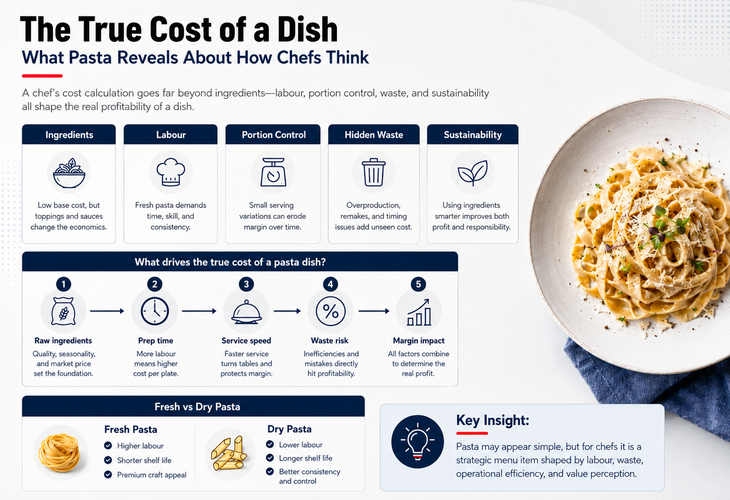
In a professional kitchen, the cost of a dish extends far beyond the ingredients on the plate. Every item on a menu reflects a series of decisions—balancing labour, preparation time, waste, and sustainability. For chefs, managing these elements is essential not only for running a profitable business but also for maintaining responsible kitchen practices.
Understanding the true cost of a dish requires looking beyond the price of raw ingredients and considering the processes behind them. Pasta is often used as an example of a high-margin menu item, but when examined closely, it reveals how labour, complexity, and waste can significantly influence profitability.
Why Pasta is often seen as a High-Margin Dish
Pasta has long been considered one of the most profitable items on many restaurant menus. At its most basic level, pasta requires only a few inexpensive ingredients: flour, eggs, and water. Compared with premium proteins such as steak or seafood, the raw ingredient cost of pasta is relatively low. This simplicity is one of the reasons pasta is frequently used to balance the economics of a menu.
However, the assumption that pasta is always a high-margin dish is not entirely accurate. The profitability of pasta depends heavily on how it is produced and what is done with it. A simple dish such as a classic carbonara may involve only egg yolk, cheese, pepper, and guanciale, in addition to the pasta itself, keeping costs manageable. In contrast, a pasta dish featuring braised beef cheek ragù, premium seafood, or slow-cooked sauces introduces higher ingredient costs and significantly more labour.
In many restaurants, pasta also plays a strategic role in menu design. When a guest sees a pasta dish priced around $30 next to a steak priced at $60, the steak can appear more reasonable by comparison. In this way, pasta not only generates profit on its own but also helps shape how customers perceive the value of the entire menu.
Labour: The Hidden Cost Driver
While pasta ingredients may be inexpensive, labour often becomes the defining cost factor. Fresh pasta production requires time, technical skill, and consistency—from mixing and resting dough to shaping and portioning. Any inconsistency can lead to rework, increasing both labour hours and waste.
To manage this, kitchens adopt different operational approaches. Some rely on batch production to improve efficiency, while others source pasta externally to reduce labour demands.
In today’s environment, where skilled labour is increasingly constrained, these decisions carry even greater weight. Dry pasta offers a practical solution by reducing preparation time and reliance on specialised skills. Its consistency allows kitchens to maintain quality while operating more efficiently, particularly in high-volume or labour-constrained settings.
Rather than viewing fresh and dry pasta as competing choices, they are better understood as strategic options—each suited to different operational priorities. In professional kitchens, time is money.
The Role of Portion Control
Portion control is one of the most important tools chefs use to maintain profitability. Even small variations in portion size can significantly affect food costs over time, particularly in high-volume kitchens.
To prevent this, pasta is often pre-portioned before service. For example, individual portions might be weighed to 200 grams and stored in containers ready for cooking. This ensures consistency in both presentation and cost, allowing the kitchen to predict how much product will be used during service.
However, maintaining strict portion control becomes more challenging during busy periods. When a kitchen is operating at full capacity, the priority shifts toward speed and efficiency. In these moments, chefs may rely more on instinct than precise measurements, which can lead to slightly larger portions and increased food costs. While these differences may seem minor in the moment, they accumulate over the course of a service or an entire week.
Hidden Waste in Pasta Production
Waste in a professional kitchen is not always immediately visible. In pasta production, it can occur during preparation, cooking, or service.
Although dough can often be reused during preparation, errors in production may still lead to entire batches being discarded. During service, overcooking, timing issues, or plating mistakes can result in dishes being remade. These small but frequent occurrences contribute to what is often referred to as “hidden waste.”
Dry pasta provides a clear advantage in this area. Its longer shelf life reduces wastage, while its ability to be cooked in precise quantities improves control during service. In contrast, fresh pasta requires more careful planning and carries a higher risk of wastage due to overproduction.
By improving predictability and reducing variability, dry pasta helps kitchens better manage both waste and cost.
Sustainability and Profitability in Modern Kitchens
Modern chefs must think carefully about how to minimise waste while maintaining quality and efficiency. Sustainability is no longer just an ethical consideration; it is also a financial one. Reducing waste and using ingredients creatively allows kitchens to maximise the value of every product they purchase.
Pasta often becomes part of this strategy. Restaurants may incorporate leftover ingredients or trim from other dishes into sauces, ragus, or fillings. By doing so, chefs can transform potential waste into profitable menu items.
This approach reflects a broader shift in the industry toward smarter resource management. Every ingredient, every hour of labour, and every portion served contributes to the true cost of a dish.
Looking Beyond the Menu Price
For diners, the price of a dish on a menu may appear straightforward. In reality, that price reflects a complex balance of ingredients, labour, time, and operational costs such as electricity, gas, and rent.
Pasta, despite its reputation as a simple and profitable dish, demonstrates how these hidden factors shape the economics of a restaurant kitchen. What appears to be a basic plate of food is often the result of careful planning and constant decision-making behind the scenes.
Understanding these dynamics reveals how chefs approach sustainability and profitability in everyday kitchen operations—and how even the simplest dish can carry a much deeper cost than it first appears.
By: Chef Brett Kerr